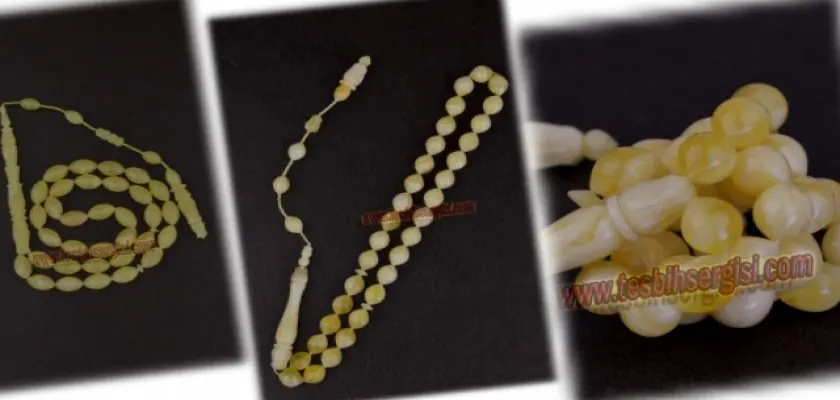
How Should the Rosary Beads Be Strung?
Kazaziye art is believed to have been first used by the Lydians from the Mesopotamian Civilizations, but it has been known to be used in our country since 1914. With the conquest of Trabzon by Fatih Sultan Mehmet in 1461, a border was established with Tsarist Russia. In 1914, this art began to be applied for the first time in our country with the settlement of kazaziye masters who came with the Tsarist Russian army to Trabzon. In time, with the kazaziye art that the Turks learned and developed, it is applied in making tassels, jewelry, or accessories for rosaries. This application, made from 24-carat pure gold and 1000-carat pure silver, is a very difficult and time-consuming endeavor. It is made by drawing gold or silver as thin as a strand of hair and winding it tightly with the help of a lathe onto a silk thread called ibrişim. The application of kazaziye art in making amber rosaries provides a very elegant appearance. The bead (tan) forming the main element of the rosary, consisting of beads with holes in the middle after passing through various stages of production, is called 'habbe'. The smaller ones, called 'zenne-female rosary', have a diameter ranging from 4-11 mm. Different sized beads can be used in those used for collection purposes. Beads are also made in spherical, round, bullet-shaped, elliptical, and cylindrical shapes.
What are the Stages of Making a Rosary?
After the material to be used in its making is selected, it is made ready for use after passing through 6 stages, including cutting, rounding, drilling, lathe processing, polishing, and stringing. First, the material is roughly cut and rounded with the help of a spinning sandpaper. While spinning rapidly, its center is drilled with a 0.07 mm diameter drill bit. After the lengths and diameters are aligned by the lathe process, each piece is polished separately and carefully strung onto a silk thread of the same color as the bead, completing the process. The markers, which protrude outwards between the beads, are placed. In rosaries with 99 beads, they are placed between the 33rd and 66th bead, while in rosaries with 33 beads, they are strung between the 5th, 7th, or 11th bead. The 'imame', where the ends of the two threads meet, is the section that artisans pay particular attention to in making amber rosaries. The 'imameler', made by carefully passing rings between their segments, require great craftsmanship. After the knot is made, 3 more intermediate beads are added. The tip is formed by twisting the ends of the two threads together. The tassel is attached by fixing it with a nail.
www.tesbihsergisi.com